- Make a T-Chart
- Label the first column: Original Seven Commandments
- Label the second column: Old Major's Speech
- In the first column, list each of the second commandments
- In the second column, list anything Major warned against that doesn't appear as a commandment
- If something appears as a commandment that Major didn't warn about, put a star next to it.
Showing posts with label Essay. Show all posts
Showing posts with label Essay. Show all posts
Monday, June 10, 2013
Pre-AP English II: T-Chart for Animal Farm Chapters 1 & 2
The first essay option in the Summer Assignment addresses Santayana's assertion that one must remember history in order to have a chance to avoid repeating it. To see how the animals may have already started forgetting things, complete the following mini-project (we did this in class for a grade, so if you were absent, make sure you show it to me after you complete it):

Friday, March 22, 2013
Pre-AP English II: Persuasive Essay / Thoughts vs. Actions
If you missed class today, you missed an opportunity to write an End of Course-style Persuasive Essay. In approximately 45 minutes (and 26 lines) please respond to the following prompt:
Write an essay stating your position on which is more important: what a person thinks or what a person does. Be sure to —At the end of the essay please answer the following question: What are 2 clues in the prompt/"be sure to..." that inform you that you should write a persuasive, rather than an expository, essay? (Bullet points are fine.)
- state your position clearly
- use appropriate organization
- provide specific support for your argument
- choose your words carefully
- edit your writing for grammar, mechanics, and spelling
Thursday, February 28, 2013
Pre-AP English II: Plot v. Theme
Click through the following examples to see how to change a plot-based statement into a theme-based statement.
Sunday, February 24, 2013
Pre-AP English II: IWA Sample
In class on Friday we walked through the IWA thesis. We ran out of time before we got to the body paragraph. So here's a walkthrough on both....
The thesis paragraph has two parts. One part is the thesis, what you'll prove in your essay, which will include the theme of the novel (a theme is always a complete sentence). The other part is how you'll prove it, what literary devices you'll use to prove your thesis.
In the first body paragraph, you'll use text evidence from the novel to make your point using the first literary device mentioned in your thesis paragraph. In the case of this essay, you'll need the symbolic characters' names as part of your quoted evidence.
In the second body paragraph, I'd look at two ironically-named characters, and analyze how the irony in their names demonstrates the falsity of the society.
Of course, in your essay you'll be looking at names and name changes, but you'll still need at least two quotes from the book to make your case for each body paragraph (four total for an 85%, six total for 100%).
The thesis paragraph has two parts. One part is the thesis, what you'll prove in your essay, which will include the theme of the novel (a theme is always a complete sentence). The other part is how you'll prove it, what literary devices you'll use to prove your thesis.
Ayn Rand uses the names of her characters to add to the meaning of her work. She uses symbolism and irony to help the reader understand that collectivism is based on lies.The paragraph would probably be a little better if I revised it so the theme appeared in the first paragraph, something like this:
Ayn Rand uses the names of her characters to help the reader understand that collectivism is based on lies. She accomplishes this with the symbolism and irony inherent in her characters' names.
In the first body paragraph, you'll use text evidence from the novel to make your point using the first literary device mentioned in your thesis paragraph. In the case of this essay, you'll need the symbolic characters' names as part of your quoted evidence.
Nowhere is this more apparent than in the scene involving Equality 7-2521's visit to the Home of Scholars in Chapter VII. "Collective 0-0009, the oldest and wisest of the Council" quizzes Equality 7 about his discovery of electric light. When Equality 7 says he worked on the invention on his own, Collective 0 says, "'What is not thought by all men cannot be true.'" Clearly, this is a lie. Collective 0's name acts symbolically for the collectivist society Rand so strongly opposes. By putting the falsehood in his mouth, Rand implies that the collectivism he represents is also based on lies.To complete this body paragraph, I'd need to look at another symbolic name and link it to a lie of the collectivist society, too.
In the second body paragraph, I'd look at two ironically-named characters, and analyze how the irony in their names demonstrates the falsity of the society.
Of course, in your essay you'll be looking at names and name changes, but you'll still need at least two quotes from the book to make your case for each body paragraph (four total for an 85%, six total for 100%).
Thursday, February 14, 2013
English Students: "Moving" Expository Essay Prompt
Read the information in the box below.
Did you read the information in the box above? Think carefully about your shame, and your shame for reading this paragraph, too.
Write an essay explaining the effect moving to a new place can have on a person’s life. Be sure to —
| Why are you reading the information in this box? You are wasting time. Even if there were something relevant in this box, it would not help you write your essay successfully. It would only result in your essay sounding like everyone else’s essay, and that will hurt your score. |
Did you read the information in the box above? Think carefully about your shame, and your shame for reading this paragraph, too.
Write an essay explaining the effect moving to a new place can have on a person’s life. Be sure to —
- clearly state your thesis
- organize and develop your ideas effectively
- choose your words carefully
- edit your writing for grammar, mechanics, and spelling
Thursday, February 7, 2013
Pre-AP English II: IWA for Anthem
Base your IWA on one of the following prompts:
Extensive plot summary will result in a REDO grade (no points), not a REVISE (85 points). Look at diction, metaphor, imagery, etc., and how the author’s use of these techniques contributes to meaning.
Remember that only REVISE and ACCEPTED essays will be taken for a grade, so submit your IWA early, rather than at the last minute to ensure that your essay will count!
*** More than 10 careless spelling mistakes***
will result in a REDO grade
All essays must be typed and adhere to the MLA formatting requirements (see below). All essays must be submitted with the draft in the LEFT pocket (inside front cover) of a 2-pocket portfolio folder. Failure to meet these minimum requirements will result in the draft being returned to the student unevaluated and with no score recorded.
85 Minimum Deadline: Friday, February 22
Drop Dead Deadline: Friday, March 1
Novelists and playwrights often use the names of their characters to add meaning to their work.In a well-organized essay, analyze the significance of character names and name-changes in Anthem, and explain how they contribute to the novella’s meaning.Tips to success:
Darkness and light have long been used to symbolize ignorance and knowledge or sin and redemption. In a well-organized essay, analyze Rand’s use of darkness and light in Anthem, and discuss the way these symbols contribute to the overall meaning of the novella.
Extensive plot summary will result in a REDO grade (no points), not a REVISE (85 points). Look at diction, metaphor, imagery, etc., and how the author’s use of these techniques contributes to meaning.
Remember that only REVISE and ACCEPTED essays will be taken for a grade, so submit your IWA early, rather than at the last minute to ensure that your essay will count!
will result in a REDO grade
All essays must be typed and adhere to the MLA formatting requirements (see below). All essays must be submitted with the draft in the LEFT pocket (inside front cover) of a 2-pocket portfolio folder. Failure to meet these minimum requirements will result in the draft being returned to the student unevaluated and with no score recorded.
- Type your paper on a computer and print it out on standard, white 8.5 x 11-inch paper.
- Double-space the text of your paper (paragraph settings). Use Times New Roman (Garamond if you're “fancy”); the font size should be 12 pt. (font settings).
- Leave only one space after periods or other punctuation marks.
- Set the margins of your document to 1" on all sides.
- Indent the first line of paragraphs one half-inch from the left margin. MLA recommends that you use the Tab key as opposed to pushing the Space Bar five times, or set your paragraphs to indent the first line 0.5". Do not skip a line (i.e., leave a blank line) between paragraphs.
85 Minimum Deadline: Friday, February 22
Drop Dead Deadline: Friday, March 1
Wednesday, January 30, 2013
Pre-AP English II: Ain't I a "Whatever" Essay
In class today, we worked on our own versions of Sojourner Truth's speech, "Ain't I a Woman."
In preparation for the assignment we listed stereotypes someone might have about some aspect of our lives (race/ethnicity, gender, occupation, neighborhood, size, athletic or intellectual ability, etc.) and how we don't fit that mold.
For instance, my information looked like this:
An area of my life where I defy/contradict stereotype:
The next step was to write an essay similar to Sojourner Truth's. Our first paragraph was devoted to establishing how we aren't like what other people expect. Our body paragraphs each addressed one of the stereotypes that we defy/contradict. Below is my opening:
In preparation for the assignment we listed stereotypes someone might have about some aspect of our lives (race/ethnicity, gender, occupation, neighborhood, size, athletic or intellectual ability, etc.) and how we don't fit that mold.
For instance, my information looked like this:
An area of my life where I defy/contradict stereotype:
- English Teacher
- English teachers are boring
- English teachers always have their noses stuck in books
- English teachers have perfect grammar and spelling
- I incorporate humor into my classes
- I celebrate student achievement in weird and wonderful ways like wearing a prom dress or shaving my head
- I watch a lot of television, especially cartoons and crime/mystery shows
- Sometimes I write short stories
- I frequently use grammar ironically or pronounce words they way they're spelled (high-per-bowl for hyperbole)
- I'm human. I make mistakes.
The next step was to write an essay similar to Sojourner Truth's. Our first paragraph was devoted to establishing how we aren't like what other people expect. Our body paragraphs each addressed one of the stereotypes that we defy/contradict. Below is my opening:
Sometimes people make assumptions about me when they hear I'm an English teacher. Like they think they know me. Like they think I have to behave they way they expect. But I'm not that way ... for reals.You modify my introduction, or use a variation of Sojourner Truth's, or come up with your own.
For instance, people think that I must always use proper grammar and spelling. But sometimes I don't, and ain't I an English teacher? Using slang and other colloquialisms makes the language fun, and I want my students to enjoy learning English. Still, people think that English teachers want the language to be stuffy. I'm not that way, and ain't I an English teacher?
Tuesday, January 8, 2013
Pre-AP English II: Stave Five Essay Prompt
In a well-developed essay*, explain how dramatic irony contributes to
the reader’s experience in Stave Five of Dickens’ Christmas Carol. (If you were absent from class, please spend no more than 45 minutes working on your essay and don't write more than 26 lines on your page.)
[Be sure to identify what it is the reader knows that a character doesn't (dramatic irony); “reader's experience” = “enjoyment”)
*paragraphs, embedded text evidence, thesis, etc.
[Be sure to identify what it is the reader knows that a character doesn't (dramatic irony); “reader's experience” = “enjoyment”)
*paragraphs, embedded text evidence, thesis, etc.
Tuesday, December 18, 2012
Pre-AP English II: IWA #2 (Better Late Than Never)
[Wasn't aware I hadn't posted this....]
Write a response to the following prompt:
Focus on only one of the novellas. Focusing on both The Pearl and A Christmas Carol will immediately result in a REDO grade (no points). If you want to use A Christmas Carol, you must complete reading it in time to proceed through the IWA process.
Do not simply recount the plot or attributes of the characters. Extensive lack of focus on literary devices/technique will result in a REDO grade (no points), not a REWRITE (70 points).
The earlier you turn in a draft that you expect to earn an 85 (only revision is needed) the more likely you are to eventually receive an 85 (your idea of what is revision-only and my idea of what is revision-only may differ) or 100 (because you’ve made the necessary revision, or you refined your essay on your own before you turned it in).
This will be the last time a 70-point grade will be given on an IWA. Last year many students who had never bothered to rewrite an essay during the first semester had a very difficult time during the second semester when an 85 was required to avoid P.A. and/or IWA n.1.
This is also the last time IWAs may be turned in handwritten. Please see the note on the bonus in the next paragraph.
Paper should be about two-pages long, handwritten, or one-page long, typed, double spaced, 12-point Times New Roman (or Garamond, if you’re fancy). Five bonus points will be awarded to properly typed essays.
Daily P.A. for submitters not having achieved a 70 begins Wednesday, December 12, 2012
Drop-Dead (“For Reals”) Deadline: Tuesday, January 8, 2013.
IWA 2.1 and Daily P.A. will be assigned on to students who do not successfully complete this assignment begins Wednesday, January 9, 2013.
Write a response to the following prompt:
Ralph Waldo Emerson once said, “Money often costs too much.” Both The Pearl and A Christmas Carol explore the paradox that wealth can carry a great cost to an individual, a family, and/or a community. In a well-developed essay explore the literary strategies Steinbeck or Dickens uses throughout his novella to communicate this idea to the reader.Tips to success:
Focus on only one of the novellas. Focusing on both The Pearl and A Christmas Carol will immediately result in a REDO grade (no points). If you want to use A Christmas Carol, you must complete reading it in time to proceed through the IWA process.
Do not simply recount the plot or attributes of the characters. Extensive lack of focus on literary devices/technique will result in a REDO grade (no points), not a REWRITE (70 points).
The earlier you turn in a draft that you expect to earn an 85 (only revision is needed) the more likely you are to eventually receive an 85 (your idea of what is revision-only and my idea of what is revision-only may differ) or 100 (because you’ve made the necessary revision, or you refined your essay on your own before you turned it in).
This will be the last time a 70-point grade will be given on an IWA. Last year many students who had never bothered to rewrite an essay during the first semester had a very difficult time during the second semester when an 85 was required to avoid P.A. and/or IWA n.1.
This is also the last time IWAs may be turned in handwritten. Please see the note on the bonus in the next paragraph.
Paper should be about two-pages long, handwritten, or one-page long, typed, double spaced, 12-point Times New Roman (or Garamond, if you’re fancy). Five bonus points will be awarded to properly typed essays.
Daily P.A. for submitters not having achieved a 70 begins Wednesday, December 12, 2012
Drop-Dead (“For Reals”) Deadline: Tuesday, January 8, 2013.
IWA 2.1 and Daily P.A. will be assigned on to students who do not successfully complete this assignment begins Wednesday, January 9, 2013.
Wednesday, November 28, 2012
English Classes: Timed Writing (Perseverance)
Read the information below.
Write an essay exploring the role perseverance plays in success.
Be sure to
“I think I can ― I think I can ― I think I can. ... I thought I could. I thought I could. I thought I could”Although many people quit when things get difficult, others keep trying until they accomplish what they set out to do. Think carefully about this statement.― The Little Engine That Could
( ^ link to book ^ )
Write an essay exploring the role perseverance plays in success.
Be sure to
- clearly state your thesis
- organize and develop your ideas effectively
- choose your words carefully
- edit your writing for grammar, mechanics, and spelling
Monday, November 5, 2012
Pre-AP English II: IWA Conclusion
Last week we looked at how to write a thesis paragraph and two body paragraphs (#1, #2). Today in class we looked at writing a conclusion. Essentially, the conclusion is a restatement of the thesis paragraph (make sure you use different words).
Here's an example:
Here's an example:
In the end, Bradbury has created two highly-engaging characters in Faber and Montag. If the reader is unaware of the paper/pencil allusions in their names, the experience of reading is still more than worthwhile. If, on the other hand, the reader does have an awareness of the connection between the names and the pencil/paper and mentor/mentee relationships, it takes their appreciation of Bradbury’s work to a much deeper level.You now have everything you need to write your IWA. Please compile the blocks of body text -- add some transitions of your choice to make it your own -- and turn it in in the inside front pocket of a plain two-pocket portfolio by Thursday, November 8.
Thursday, November 1, 2012
English I (Pre-AP): Timed Expository Writing (Fear in Society)
Read the information in the box below.
Sometimes fears become overblown, while other times they’re justified. Think carefully about this statement.
Write an essay explaining the role fear plays in society.
Be sure to —
Maximum length: 26 lines
| In 1933, when taking office for the first time, President Franklin Delano Roosevelt announced in his inaugural address, “We have nothing to fear but fear itself.” |
Sometimes fears become overblown, while other times they’re justified. Think carefully about this statement.
Write an essay explaining the role fear plays in society.
Be sure to —
- clearly state your thesis
- organize and develop your ideas effectively
- choose your words carefully
- edit your writing for grammar, mechanics, and spelling
Maximum length: 26 lines
Pre-AP English II: IWA Body Paragraphs, Pt. 2
Yesterday we looked at how body paragraphs should be written in an IWA. In general, each body paragraph should have two to three pieces of evidence from the text to support the main idea of the paragraph.
Yesterday's body paragraph carried the idea that the paper is dependent upon the pencil to give it meaning or significance (similar to the mentee's dependence on the mentor). Today, we'll create body text that shows how over time the mentee becomes more and more like the mentor. For instance:
Our body paragraphs need a bit more detail and transitional material, but they're in pretty good shape.
Next Monday: Conclusions
Yesterday's body paragraph carried the idea that the paper is dependent upon the pencil to give it meaning or significance (similar to the mentee's dependence on the mentor). Today, we'll create body text that shows how over time the mentee becomes more and more like the mentor. For instance:
In “The Sieve and the Sand,” Faber gives Montag instructions via ear-radio on how to get out of trouble. At one point he tells Montag to “‘Say ‘yes,’” and then “[Montag’s] mouth moved like Faber’s.” This simile indicates that people are seeing Faber’s influence on Montag,just as they would notice what is written on a piece of paper, rather than the paper itself.Likewise
In the “Burning Bright” section of the book, the mentor-mentee (pencil/paper) relationship between Faber/Montag becomes complete. Montag symbolically becomes Faber when he “[dresses] in Faber’s old clothes and shoes,” escaping from the Hound at the river. Like a piece of paper virtually disappears when covered in writing, Montag becomes invisible and only what appears to be Faber remains.(These two blocks of body paragraph text also demonstrate the direct answer/topic sentence, text evidence/support, commentary/connection of a good open-ended or short-answer response to an EOC question.)
Our body paragraphs need a bit more detail and transitional material, but they're in pretty good shape.
Next Monday: Conclusions
Wednesday, October 31, 2012
Pre-AP English II: IWA Body Paragraphs Pt. 1
Yesterday we looked at the thesis paragraph of the IWA. One reason the thesis paragraph is so short is because the bulk of your effort should go to your body paragraphs.
It's easy to fall into the trap of plot synopsis in an IWA, so don't. Make sure that you're analyzing the text (how Bradbury writes, in this case) rather than summarizing it (what Bradbury writes). Keep focused on the literary and rhetorical techniques he employs instead of the plot details.
We want to focus on moments in the text where the literary technique demonstrates the mentor-mentee relationship. For instance, on page 85 (81, new edition), Faber states
Next: More Body Paragraphs!
It's easy to fall into the trap of plot synopsis in an IWA, so don't. Make sure that you're analyzing the text (how Bradbury writes, in this case) rather than summarizing it (what Bradbury writes). Keep focused on the literary and rhetorical techniques he employs instead of the plot details.
We want to focus on moments in the text where the literary technique demonstrates the mentor-mentee relationship. For instance, on page 85 (81, new edition), Faber states
Now, if your suggest that we print extra books and arrange to have them hidden in firemen’s houses all over the country, so that seeds of suspicion would be sown among the arsonists, bravo, I'd say!”Montag takes Faber seriously, missing out on his verbal irony (Faber's next line includes the comment "I was joking"). Montag demonstrates, however, that he's unable to question what Faber says, just as a piece of paper cannot question what the pencil writes on it. We can analyze this in our essay as:
One place where this is evident is in the “Sieve and the Sand” section of the story. Faber employs verbal irony when he suggests that they “print extra books and arrange to have them hidden in firemen’s houses…, so the seeds of suspicion would be sown among the arsonists[. Bravo!]” Montag, like a piece of paper that cannot question what is written on it, believes Faber to be sincere in what he says.We can also use part of the story, a little earlier on page 85, where Faber remarks on a paradoxical comment Montag makes:
When Montag uses the paradox “That’s the good part of dying; when you’ve nothing to lose, you run any risk you want,” Faber congratulates him. He says, “There, you’ve said an interesting thing … without having read it.” In this way Faber mentors and encourages Montag, imprinting his wisdom like a pencil tracing across a piece of paper.We'll need to keep adding more evidence and more body paragraphs, but this is a good start.
Next: More Body Paragraphs!
Tuesday, October 30, 2012
Pre-AP English II: Intro to the IWA
Beginning with this six-weeks, students will complete an Individual Writing Assignment every six-weeks. The first one we'll write together.
The IWA begins with a prompt:
At the end of the Afterword printed in many editions, Bradbury writes
We'll start out writing two-sentence thesis paragraphs. (Once this is mastered, you may get "fancy" if you choose.) The first sentence is the thesis (what you're going to prove); the second sentence is your method (how you're going to prove it).
As the IWA is a work in progress (You write a draft, I annotate corrections on your draft essay, you revise, the cycle continues until your essay is satisfactory), we won't come up with a perfect thesis to start with, but let's try:
The IWA begins with a prompt:
In many novels character names do double duty. Not only do they suit and identify the character, but they may also act symbolically and deepen the meaning of the story. In a well-developed essay, explore how Ray Bradbury’s choice of names in Fahrenheit 451 enhances the reader’s appreciation of the work.The prompt not only tells you what to do (write about how an author's choice of character names enhances the reader's experience), but also offers a suggestion as to how you should prove your thesis (symbol).
At the end of the Afterword printed in many editions, Bradbury writes
Only recently, glancing at the novel, I realized that Montag is named after a paper manufacturing company. And Faber, of course, is a maker of pencils!Therefore we can see that symbolically the relationship between Faber and Montag is similar to the relationship between Pencil and Paper. This helps greatly in deciding the direction of our essay.
We'll start out writing two-sentence thesis paragraphs. (Once this is mastered, you may get "fancy" if you choose.) The first sentence is the thesis (what you're going to prove); the second sentence is your method (how you're going to prove it).
As the IWA is a work in progress (You write a draft, I annotate corrections on your draft essay, you revise, the cycle continues until your essay is satisfactory), we won't come up with a perfect thesis to start with, but let's try:
In Fahrenheit 451 Ray Bradbury chooses names that enhance the reader’s appreciation of the novel. As he says in the “Afterword,” Montag is symbolic of a paper company, and Faber is symbolic of a pencil manufacturer – mirroring their relationship in the story.Next up: Body Paragraphs!
Friday, October 19, 2012
Pre-AP English II: Timed Expository Writing (Tienanmen Square)
Read the information in the box below.
Although many people obey all laws, some people choose to disobey those they feel are unjust. Think carefully about this statement.
Write an essay explaining whether people should follow the law regardless of whether they feel the law is right or wrong.
Be sure to —
Maximum length: 26 lines
| In 1989, when the Chinese government declared a protest in Tienanmen Square illegal, one man chose to stand in front of a column of tanks to stop them from advancing on the protesters. |
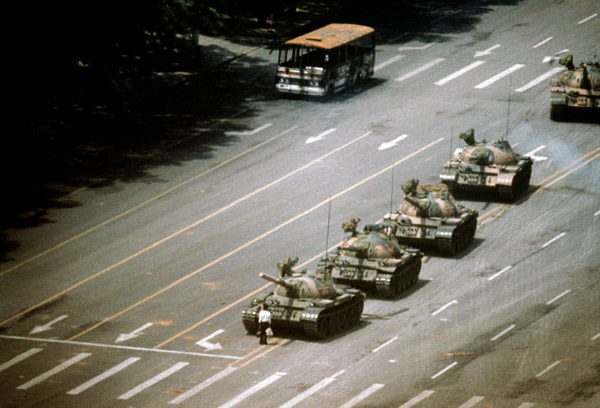
Although many people obey all laws, some people choose to disobey those they feel are unjust. Think carefully about this statement.
Write an essay explaining whether people should follow the law regardless of whether they feel the law is right or wrong.
Be sure to —
- clearly state your thesis
- organize and develop your ideas effectively
- choose your words carefully
- edit your writing for grammar, mechanics, and spelling
Maximum length: 26 lines
Saturday, September 29, 2012
Pre-AP English II: Final Draft of Expository Essay
If you weren't in class yesterday, please complete the final draft of your essay. Use this 26-lined page rather than numbering 1-26 on a lined sheet of paper.
Remember to shoot for a score point 3 or higher. Revisit this blog post for the criteria.
Remember to shoot for a score point 3 or higher. Revisit this blog post for the criteria.
Wednesday, September 26, 2012
All Pre-AP English Students: EOC-Style Expository Essay Prompt
If you weren't in class today, please write an expository essay responding to the following prompt:
Write an essay explaining the importance receiving a good education has in today's society.Please number the lines on your paper 1-26. This is about the space you'll have available for your final draft on Friday. Feel free to go beyond the 26th line on your draft. You'll need to revise it anyway.
Tuesday, September 25, 2012
All Pre-AP English Students: EOC Essay Rubric
In class today we looked at the End-of-Course (EOC) rubric for the Expository Essay. Good times.
If you missed class or would like a complete rubric of your own, please download a copy.
We looked at the information for Score Point 3 and considered the "Big Ideas" of each bullet point as follows:
If you missed class or would like a complete rubric of your own, please download a copy.
We looked at the information for Score Point 3 and considered the "Big Ideas" of each bullet point as follows:
- You must write an expository essay!
- You must have a clear thesis statement that is focused on the topic of the prompt.
- Your essay must "flow."
- You support your thesis with "specific and appropriate" details.
- Your response is "original" rather than "what everyone else is going to write about."
- Your essay has a "sophisticated" tone and demonstrates an advanced vocabulary.
- You use a variety of sentence types appropriately.
- Spelling, grammar, punctuation, usage, and other mechanics/conventions are all employed properly.
Wednesday, June 6, 2012
Last Year's Freshmen: EOC Writing
I'd like to get a handle on what worked for the essay and short story on the EOC -- and what, unfortunately in many cases, didn't. If you remember how you wrote your essay and story -- did you use the fake research company, did you use the characters we made in class, etc. -- or anything else about your strategies, please email me.
Thanks, and have a great rest of your summer.
cmikesell-at-dallasisd-dot-org
Thanks, and have a great rest of your summer.
Subscribe to:
Posts (Atom)